ankle sprain rehabilitation
Ankle sprain rehabilitation is what can turn a sidelined injury back into a confident sport. If you have twisted or rolled your ankle and you are wondering when you can safely return to training, the answer is rarely just "when the pain is gone." Recovery commonly involves a staged programme aimed at rebuilding strength, movement, balance and confidence. Completing rehabilitation may help reduce the risk of re-injury. This guide walks you through what a physio-guided ankle rehabilitation looks like: the four stages, the exercises that matter, how to test if you are ready for sport, and when to book a professional assessment.
What is ankle sprain rehabilitation, and how is it different from rest?
Most ankle sprains follow a similar four-stage rehabilitation pathway, though the time in each stage varies with the severity of the sprain (grade 1, 2 or 3), your general fitness, and how the ankle responds to loading.
The difference matters. Resting alone gives the ligaments time to settle, but it can leave the surrounding muscles weaker, the joint stiffer, and the nervous system's sense of ankle position (called proprioception) dulled. That combination is one of the most common reasons ankles might re-sprain within a few months of the first injury.
A proper rehab plan can help restore each of these systems in the right order. Most physio-guided programmes follow four stages: protect and control swelling, restore movement and early load, rebuild strength and balance, then a return-to-sport progression.
What are the stages of ankle rehabilitation?
Stage 1: Early care and swelling management (roughly days 0 to 7)
The priority in the first few days is to manage pain and swelling, support the healing ligaments, and keep you moving safely. This often includes compression, elevation, gentle range-of-motion work within pain limits and, for higher-grade sprains, short-term use of a brace or boot. Weight-bearing is introduced as pain allows.
Stage 2: Movement and early loading (roughly weeks 1 to 3)
Once the swelling settles, the focus shifts to working on full range of motion in the ankle and starting gentle strengthening. This is where you begin working the calf, the muscles on the outside of the shin (peroneals), and the small stabilising muscles of the foot.
Stage 3: Strength and balance training (roughly weeks 3 to 6)
Strength work becomes more progressive (single-leg calf raises, resisted movements, controlled hops) and balance training targets proprioception. This is an important stage of rehabilitation. Strength and balance work may help reduce the risk of recurrent sprains when returning to sport.
Stage 4: Sport-specific progression (roughly weeks 6 and beyond)
Sport-specific drills come in: change of direction, cutting, jumping and landing, and sport-specific reaction work. Progression here is guided by how the ankle responds, not by a fixed calendar.
Many people move through these stages over four to eight weeks. Grade 3 sprains and high ankle sprains (involving the ligaments between the shin and calf bones) often take longer and benefit from professional guidance from early on.
How do you strengthen and rebuild control in a sprained ankle?
Ankle rehab rests on two pillars: strength and proprioception. Strength gives the ankle the muscular capacity to absorb load. Proprioception (your sense of where the joint is in space) gives it the reflexes to respond when the ground shifts under you.
Strength progression example
- Calf raises with both feet on the ground
- Single-leg calf raises
- Single-leg calf raises with a hold at the top
- Hop-and-hold: hopping onto the injured leg and holding your landing for two to three seconds
Balance and proprioception progression example
- Double-leg standing balance
- Single-leg balance on a firm surface (30 seconds is a common target)
- Single-leg balance on an uneven surface (folded towel, cushion)
- Single-leg balance with the eyes closed
Proprioception often lags behind pain relief. Your ankle may feel comfortable but still not "know" where it is quickly enough to react during a fast sideways step in sport. This is why balance work is commonly included in ankle rehabilitation programmes. These are common examples used by physiotherapists, and they are a starting point rather than a prescription. If any exercise causes sharp pain or your ankle gives way, stop and speak to a physio for personalised progression.
How do I know my ankle is ready for sport again?
Being pain-free is not the same as being ready. Return-to-sport readiness is measured by function, not comfort. Most physiotherapists use a checklist along these lines before clearing you for sport:
- Full range of motion in the ankle, equal to the other side, with no pain at end range
- Ability to hold a single-leg balance for at least 30 seconds
- Pain-free hopping in place and hopping forward on the injured leg
- Equal or near-equal calf strength side to side
- Sport-specific movements (change of direction, cutting, jumping and landing) performed without a sense of giving way
A simple self-test you can try is the single-leg hop for distance: on a flat, non-slippery surface, hop as far as you can on each leg and compare. A large difference between sides is a sign the injured ankle still needs more work.
These tests are a helpful guide, but they are not a guarantee. Competitive athletes and anyone recovering from a grade 2 or 3 sprain benefit from an in-person functional assessment before returning to full training.
Why do ankles keep re-spraining, and how can I reduce the risk?
Incomplete rehabilitation can be one factor contributing to recurrent ankle sprains. Once an ankle is sprained, the risk of a second sprain is significantly higher, and repeated sprains over months or years can lead to what is called chronic ankle instability, often with a "giving way" feeling during everyday activities or sport.
A few practical steps that may help reduce the risk:
- Complete the full rehab stages, especially stage 3 balance and strength work, before returning to sport
- Keep training balance and proprioception even after full recovery (short daily balance work is enough for many people)
- Warm up properly before sport, including some ankle-specific movement
- Consider taping or a brace for high-risk sessions in the first months back
None of these guarantees against every re-injury, but together they build the ankle's capacity to handle load and its ability to react when something unexpected happens underfoot.
Should I wear an ankle brace when returning to sport?
For many people returning to sport after a sprain, a brace or supportive tape used during the first few weeks of full training can add confidence and mechanical support at the ankle. It is commonly used for athletes with a history of repeated sprains or for the return-to-sport phase of a higher-grade sprain.
A brace is a supplement, not a replacement. It sits on top of the strength and balance work already done and should not be treated as a shortcut past rehab. A physiotherapist can advise on the type of brace or taping that fits your sport, your ankle, and how far along in rehab you are.
When should you see a sports physio instead of self-rehabbing?
Self-rehab works for many mild ankle sprains, but there are situations where a professional assessment is the smarter starting point:
- Pain or swelling that is not improving after two weeks of self-care
- Recurring feeling of the ankle giving way, even during simple activities
- Grade 2 or grade 3 sprains (bruising, instability, difficulty bearing weight)
- Competitive athletes on a return-to-sport deadline
- Inability to bear weight at all after two to three days
For any of these signs, book an assessment sooner rather than later. Early assessment can help determine an appropriate rehabilitation plan and return-to-sport progression. Some symptoms need urgent medical review rather than physio: severe deformity of the ankle, complete inability to bear weight at 48 hours, and numbness or a cold feeling in the foot. In these cases, go directly to a doctor or emergency care.
Where can I get ankle sprain rehabilitation in Dubai?
You will find dedicated ankle rehabilitation in Dubai at DHA-licensed physiotherapy and sports clinics. At Physiowell, our sports team combines physiotherapy and osteopathy under one roof, so your ankle rehab is guided by professionals who understand the demands of running, football, padel, and other sports popular in the city.
Our clinic is on Al Wasl Road, in Al Manara, close to Safa Park and easy to reach from most of Dubai's residential and business areas. We treat recreational and competitive athletes and work with each ankle at whichever stage of rehab it is currently in.
How Physiowell guides your return-to-sport rehab
At Physiowell, ankle sprain rehabilitation is structured around the four stages above and adapted to your sport, your training goals, and your history of injury. Every plan starts with a full assessment: how the injury happened, what the ankle can currently do, and where the gaps in strength, movement, or balance are.
Your rehab is then delivered by our DHA-licensed healthcare professionals , including Rocco Profeta ( Osteopath) and Ahmad Al Nazer ( Physiotherapist), both of whom work with recreational and competitive athletes in Dubai. Rocco combines Osteopathy with a competitive age-group triathlete's understanding of endurance sport, while Ahmad brings over eight years of hands-on clinical experience with knee and ankle injuries in athletes.
The combination of osteopathy and physiotherapy under one roof means we can adjust the plan as your ankle progresses through the stages of rehabilitation, and support the surrounding hips, knee, and foot as needed.
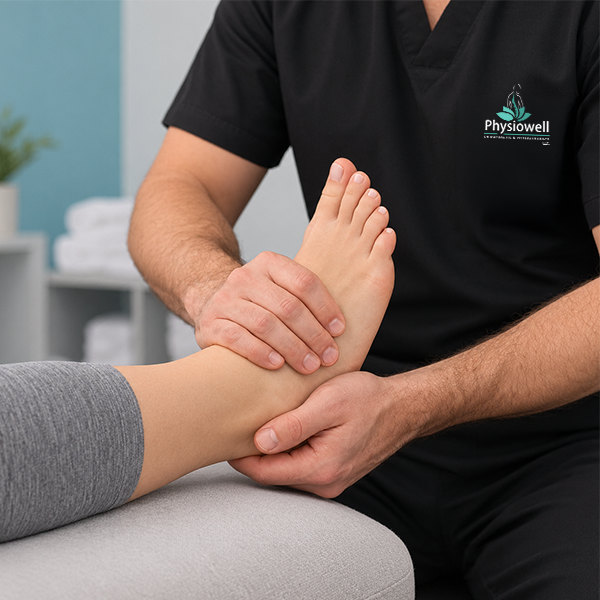
Book your sports physio session at Physiowell in Dubai
When your ankle is ready for a professional plan, book an assessment at Physiowell and start a rehabilitation programme built around your sport. Whether you are targeting a race, a padel league, or simply your regular runs at Safa Park, our team will work with you at every stage of the return.
Physiowell, Al Manara, Al Wasl Road, Villa 947, Makani 19841 82767, Dubai, UAE.
- Landmark: in Al Manara, on Al Wasl Road, close to Safa Park
- Parking: free on-site valet and street parking available
- Opening hours: Sunday 9am to 6pm, Monday to Friday 9am to 7pm (closed Saturday)
- Phone: +971 4 269 2121 | WhatsApp: +971 4 269 2121 | info@physiowell.ae
- Facility license number: 6471536